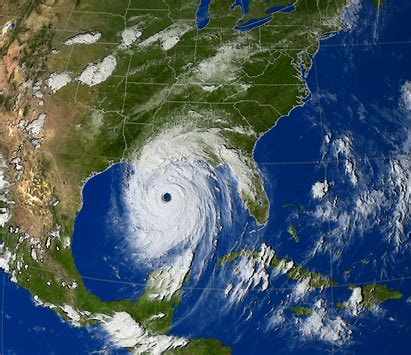
Theologian and author Diane Butler Bass watched the ocean churn as Hurricane Erin brushed the shore of North Carolina and reflected on the edges of a hurricane as a movement. She saw the chaotic and dangerous waves and felt the forceful winds. She knew once the storm subsided, transformation would be its result. The ground below her feet would no longer be the same as it was.
Bass’s yoga leader described hurricanes as strange storms, wild, unpredictable and destructive, but with a center that is completely silent and still. She remembered, too, a conversation with the former Archbishop of Canterbury about change and innovation in faith communities. “You know, change rarely happens in the center. The creative energy comes from the edges.” Edges and centers so often reflect the journey of faith.
When the winds die down and the ocean recedes, the beach won’t be the same. The same is true in our own faith journeys, “when the turmoil ends the edge will be in a new place; the shoreline of our understanding and experience will have shifted. The landscape will have been transformed” (Bass).
What about that calm center? Bass quotes from Wikipedia: “Many aspects of this process remain a mystery. Scientists do not know why a ring of convection forms around the center of circulation instead of on top of it, or why the upper-level anticyclone ejects only a portion of the excess air above the storm.”
Without a center, a storm is just a storm, and as Bass asserts, “You might say that the edges aren’t even possible without the still center.” But too long in the comfort of one spot and we lose our creative edge. There is little transformation or growth. In the structure of a hurricane, the center does not last long, but it is certain.
“The center and edges are, however, part of a single structure as an interdependent spiraling system of calm and chaos, of clarity and creativity,” says Bass. The edges are always chaotic. But those are the places of greatest creativity. And yet, the edges depend on the center’s stability for their very existence. Creation’s process is also a mystery of human growth and development in the turbulence that is life, and faith. Jesus was edgy, real edgy. What he asks of his disciples, what he asks of us is a dramatic transformation in how we see and interact with one another. It is dangerous.
Let us be willing to live on the edge. It feels chaotic yet creative. Where is the certainty? Who knows what will happen? What we know is when we keep Jesus at the center, we find our “eyes” to see God working in all the spirals around us. We have confidence transformation will occur. We will become something new, something glorifying God in ways that we cannot sit still and imagine.
Love is a verb. It is always active.
 Union Congregational Church of Magnolia
Leave a comment